

Travel eSIM Guides
Updated for 2026Based on firsthand experience, provider research, and Travlists Booking Insights.
Hi, I’m Julian, co-founder of Travlists. Before we go into the eSIM guides, here’s a quick story about why this became one of the main topics on Travlists.
I started this site in late 2022, when there were only a handful of eSIM providers and almost no blogs helping travelers compare them properly. Before I even launched, I reached out to an industry contact who had just moved to an eSIM company and asked him directly: Do you see eSIMs becoming the next essential travel item, like SIM cards and pocket WiFi?
I was honestly unsure. I wasn’t ready to swap my handy SIM cards just yet. But he said yes without hesitation. That conversation shaped everything I’ve built here.
Since then, I’ve covered unlimited data plans, voice-enabled eSIMs, regional vs. single-country options, device compatibility, and setup guides—based on provider research, reader booking behavior, and firsthand usage across South Korea, Hong Kong, the Philippines, and Japan. Eisaku also contributes local notes and firsthand context for some Asia-focused guides, especially Korea and Japan.
I’ve personally tested many reputable providers, though I won’t claim to have tested every destination or provide speed data for countries I haven’t visited. What I can give you is an honest provider overview: what each one is best for, where Travlists readers book them most, which plans are worth booking for short and long-term trips, and where the downsides start to matter.
Over the years, I’ve also built a dataset of what readers actually book through Travlists. That data informs my recommendations about which eSIMs I would buy—and which ones I would skip.
Find an eSIM by Destination
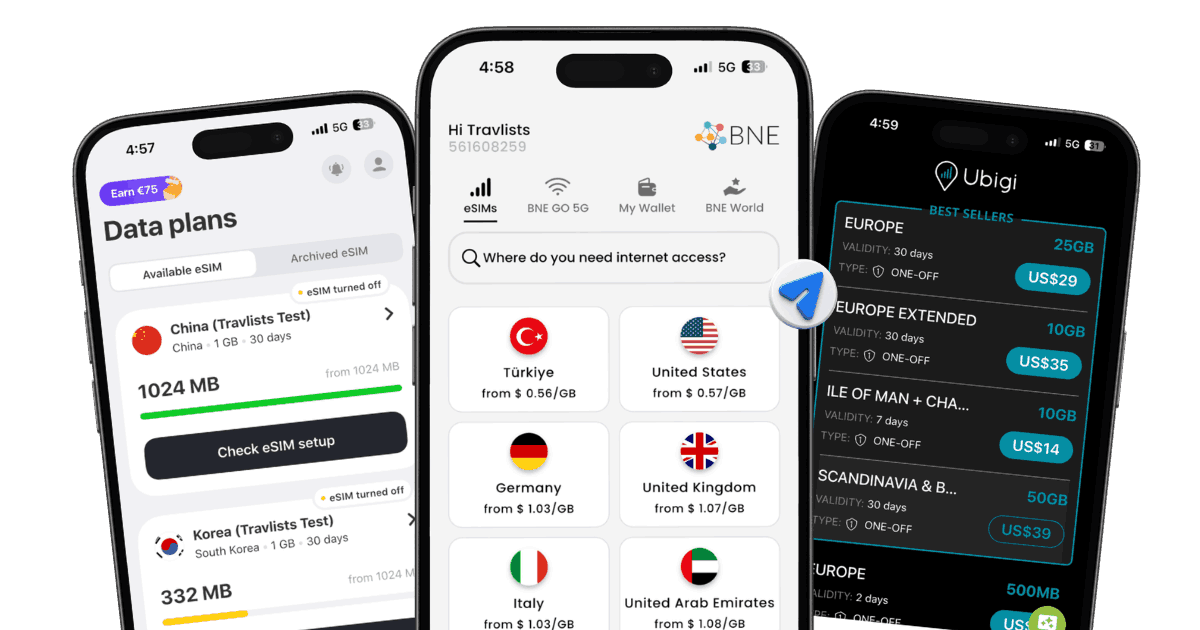
If you’re already planning your next trip—or perhaps you’ve already landed—this is the best place to start.
Every destination has different mobile networks, coverage, pricing, and travel needs. That’s why I don’t recommend the same eSIM for every country. Some providers connect to the strongest local carriers, while others don’t.
As a traveler, I understand why booking directly through an eSIM provider feels like the safest choice. However, I’ve also found that many providers don’t always offer the same level of customer support, loyalty programs, multi-use eSIMs, or promotional offers available elsewhere.
Instead, every Travlists destination guide is researched independently to help you compare providers, understand the available plans, and choose the option that best fits your trip.
Asia Pacific
Asia Pacific is where I’ve spent the most time researching and using travel eSIMs. Many of these guides are supported by firsthand experience across South Korea, Japan, Hong Kong, and the Philippines, together with provider research and Travlists Booking Insights.
Europe
Europe is one of the few regions where travelers have a genuine choice between regional and country-specific eSIMs.
If you’re deciding between a Europe-wide plan and a country-specific option, keep that in mind before purchasing.
North America
Besides country-specific plans, you’ll also find several regional combinations that work well for multi-country trips.
For example, I found that Klook offers plans that cover the United States & Canada, United States & Hawaii, and even United States, Mexico & Guam, making them worth comparing if you’re visiting more than one destination.
Central & South America, Caribbean
Middle East & Africa
More destination guides are added regularly as Travlists continues expanding its travel coverage.
Search for eSIM guides, transport passes, visas, attractions, and other travel topics on Travlists.
Traveling Across Multiple Countries?
Not every trip stops at one destination.
Years ago, some friends and I visited Hong Kong and Taiwan on the same trip. Back then, travel eSIMs weren’t really an option, so we bought separate tourist SIM cards for each destination. It worked, but it also meant swapping SIM cards, keeping track of tiny plastic cards, and buying a new one every time we crossed a border.
If I were doing that same trip today, I’d seriously consider using a regional eSIM instead.
Regional eSIMs let you stay connected as you move between countries without installing a new eSIM every time you cross a border. For many travelers, that’s the biggest advantage.
That said, convenience isn’t always the cheapest option. Depending on your itinerary, two single-country eSIMs may offer better value—or even stronger local network coverage—than one regional plan. Consider your travel plans before deciding to get a regional eSIM.
Choose an eSIM Provider by Travel Style
Sometimes your travel style matters more than your destination. Instead of comparing eSIM plans per country or region, you can also start by thinking about your internet usage, what kind of features you want, and the kind of trip you’re planning.
Heavy Internet Users & Always-On Travelers
If you’re constantly online, working remotely, streaming videos, uploading content, or simply don’t want to top up in the middle of your trip, consider getting an eSIM with unlimited data. You can simply pick a plan that matches the duration of your trip, install the eSIM, and you won’t have to worry about losing data.
What I RecommendLong-Term Travelers
If you’re traveling for several weeks or months, you’ll probably value flexibility more than finding the absolute cheapest plan. There are several providers that suits the needs of students, traveler employees, and other tourists planning an extended stay.
What I RecommendCruise Travelers
To get a data connection when you dock in Europe, Asia, or the Caribbean, you can use an eSIM instead of looking for a local SIM card or pocket WiFi once you’re ashore. These providers claim to offer connectivity in ports and near the shore, but I’d recommend reading their terms and coverage carefully before purchasing, since cruise connectivity can vary a lot by route and cruise line.
What I RecommendFamilies & Couples
If you’re getting eSIMs for your group, look at providers that offer incentives for multiple purchases. Some brands give higher cashback the more you buy, and a few have lower-cost plans that end up being better value once you add up the whole group’s data.
What I RecommendTravelers who need eSIMs with Phone Numbers
Most travel eSIMs only provide mobile data. If you need a phone number for calls, SMS, or certain verification services, there are a few providers that you can consider, especially if you want to avoid high roaming costs. Most do not provide a local number for all countries, but many do have optional plans that come with an international phone number.
What I RecommendeSIM Provider Reviews & Comparisons
When I first bought an eSIM for a family trip, my first thought after a quick Google search was: “Aren’t most eSIM brands basically the same, except for the price?” But after using and reviewing different providers over the years, my conclusion is simple: they are not all the same.
Coverage, network partners, activation process, app experience, customer support, phone number options, VPN features, regional plans, and overall flexibility can vary significantly between providers.
Below are the providers I’ve personally reviewed on Travlists. Listed alphabetically, not by preference.
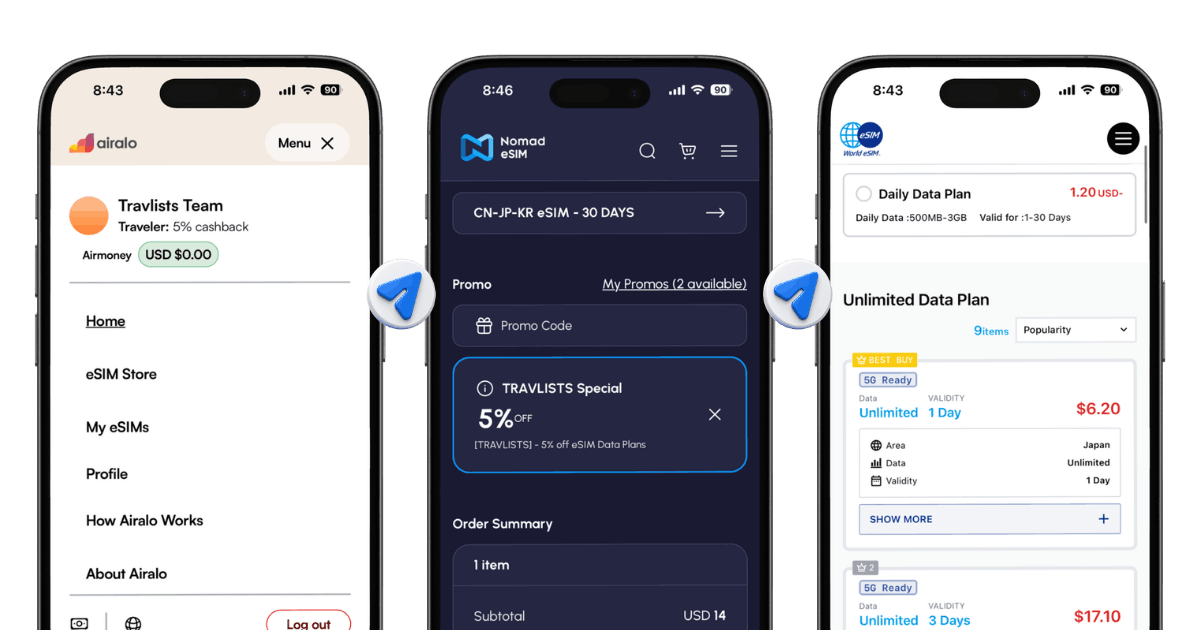
Airalo
Airalo is one of the largest travel eSIM marketplaces available today. The company describes itself as the world’s first eSIM store and says it now serves more than 30 million users across 200+ countries and regions.
Airalo is usually one of the first providers I check when researching a new destination because of its broad coverage. While it isn’t always the cheapest option, it often supports destinations that smaller providers don’t.
Read the Airalo eSIM Review →BNESIM
BNESIM has become one of my favorite providers for travelers looking for flexibility and long-term value. Besides competitive pricing, BNESIM offers fixed-data plans, optional non-expiring data, cashback rewards, an international phone number, VPN add-ons, and one of the most generous discount programs I’ve seen among major providers.
I’ve personally used BNESIM several times, and it was also the first travel eSIM my family used together.
Read the BNESIM eSIM Review →Nomad
Nomad is one of the providers I usually compare when a trip involves visiting several countries. I particularly like that it goes beyond the standard Europe plans by offering regional options such as East Asia and Southeast Asia + Oceania, making it useful for itineraries that cross multiple borders without requiring a global plan.
Read the Nomad eSIM Review →Saily
Saily is the eSIM created by the team behind NordVPN, and what sets it apart from most providers I’ve tested are the free security tools built into its app, including an ad blocker and Virtual Location. When I tested Saily in Seoul, the eSIM installed in about a minute through the app’s guided setup, and the ad blocker noticeably cleaned up the websites I visited.
Saily also offers an optional US phone number, regional and global plans, and Saily Ultra, a monthly subscription that bundles data with airport lounge passes and a NordVPN subscription.
Read the Saily eSIM Review →Ubigi
Ubigi is best known for Japan, where it has built a strong reputation among travelers. It is also worth comparing for destinations such as the Philippines, Malaysia, and the Dominican Republic, where we’ve seen steady interest from Travlists readers.
For longer stays, Ubigi’s monthly and annual subscriptions can be attractive for digital nomads and frequent travelers who prefer subscription-style plans. Ubigi also offers a loyalty program called UbiClub, which rewards users with up to 8% UbiCoins.
Read my Ubigi eSIM Review →World eSIM
World eSIM isn’t as well known as some of the larger global providers, but it comes from a company with a long history in travel connectivity. It is operated by Vision Inc. Group, the same group behind Global WiFi, the international pocket WiFi rental service that says it has served 24 million travelers as of January 2026.
One feature I particularly like is its daily data plans, alongside traditional fixed-data and unlimited options.
Read the World eSIM Review →Yesim
Yesim is one of the providers I recommend most often when travelers ask about unlimited data. The activation process is straightforward, coverage is strong across many destinations, and its global plans make it convenient for travelers who don’t want to install a new eSIM every time they fly.
It also includes several extra features that set it apart from many competitors.
Read the Yesim eSIM Review →Other eSIM Provider Reviews
Besides the main providers above, Travlists also covers smaller or more specialized eSIM providers that may be worth comparing depending on your destination, budget, or travel style.
Before You Buy an eSIM
Buying a travel eSIM is much easier than it was a few years ago.
When I first started covering eSIMs, almost every provider focused on installation using a QR code. Coming from years of buying tourist SIM cards and renting pocket WiFi, the whole process felt unfamiliar, and I’ll admit I was hesitant to make the switch.
Today, things are much simpler. Most providers let you install your eSIM directly through their app, while others still offer QR code installation. Some even advertise “one-tap” or “one-click” installation. In my experience, this usually refers to installing the eSIM onto your phone—not activating your mobile data, which typically happens later according to the provider’s activation policy.
Check If Your Device Supports eSIM
Quick Check
Dial *#06#. If your phone displays an EID, it generally supports eSIM. Also confirm it’s carrier-unlocked under Mobile Network, Cellular, or SIM management in your settings — most carriers unlock for free once contract conditions are met.
Regional Exceptions
Compatibility can depend on where your phone was bought, not just the model. Most South Korea-market Samsung Galaxy phones don’t support eSIM, with exceptions including the S23, S24, Z Fold 4, Z Fold 5, Z Flip 4, Z Flip 5, and A54 5G. Galaxy phones from mainland China, Hong Kong, and Taiwan have similar restrictions. Most iPhones from the XS and XR onward support eSIM, though units sold in mainland China generally don’t.
How Many You Can Store
iPhones store 8+ eSIM profiles, with two active at once on iPhone 13 and newer. Samsung Galaxy devices store up to 20, though most run one active eSIM at a time. Either way, you don’t need to delete an old travel eSIM to install a new one — you can keep several stored and switch which one’s active.
How Much Data Will You Actually Need?
Use the Travlists Trip Data Calculator below to estimate how much data you’ll need based on your destination, trip length, daily usage, and the apps you use most.
If you use more data than expected, most providers allow top-ups without installing another eSIM.
Do You Need a Phone Number?
Most travel eSIMs only provide mobile data. If you need calls, SMS, or verification codes, compare providers that offer phone numbers or voice services.
- aloSIM offers international phone numbers and calling credits.
- Airhub offers selected plans with voice services.
- Yesim offers virtual numbers for supported services.
Traveling to China?
China blocks many services travelers use every day, including Google, Gmail, YouTube, Instagram, Facebook, and WhatsApp.
Some travel eSIMs allow access without additional setup, while others may require a VPN. Always check how your chosen provider handles mainland China before buying.
When Should You Install Your eSIM?
I usually recommend purchasing your eSIM before your trip so everything is ready before departure.
Installing before departure is especially helpful if your provider uses QR code activation because you’ll need a stable internet connection during setup.
Travlists Trip Data Calculator
Estimate how much data you may need based on your destination, trip length, apps, daily usage, and device.
Assumes roughly 5–7 hours of daily connectivity. For a result based on your exact trip, use the interactive calculator when it loads.
| Trip length | Light messaging, maps |
Moderate + social, work |
Heavy + video, uploads |
Power / Unlimited |
|---|---|---|---|---|
| 1–3 days | ~1 GB | ~3 GB | ~5 GB | ~8+ GB |
| 4–6 days | ~3 GB | ~7 GB | ~12 GB | ~21+ GB |
| 7–15 days | ~7 GB | ~16 GB | ~27 GB | ~46+ GB (consider unlimited) |
| 16–30 days | ~15 GB | ~33 GB (consider unlimited) | ~57+ GB (unlimited) | Unlimited |
| 30+ days | ~22 GB | ~50+ GB (unlimited) | Unlimited | Unlimited |
eSIM Compatible Phones & Devices
To recommend eSIMs for iPhone, Samsung Galaxy, Google Pixel users, and other devices, I reviewed the compatibility pages from major eSIM providers before writing this section, including Airalo, BNESIM, Yesim, Ubigi, Nomad, Saily, and Klook. Compatibility lists are useful, but they are not perfect. Support can still vary by exact model number, country of purchase, carrier lock status, and provider installation process. Providers also update their lists of eSIM-compatible devices, so check again before purchasing.
Which eSIM Provider Works Best for Your Device
iPhone
Any provider on Travlists works for standard unlocked iPhones. Coverage is consistent across Airalo, BNESIM, Yesim, Ubigi, Nomad, Klook, Saily, and Airhub.
Choose your provider based on plan pricing and destination coverage — not compatibility. One feature worth considering is that Yesim provides a free VPN for iOS, which can be helpful for keeping your data more private while traveling.
I have personally tested BNESIM and Yesim on my iPhone 15 Pro, and both worked smoothly in my own setup.
Exception: iPhones purchased in mainland China do not support eSIM on most models. The iPhone Air is the first exception — Apple made it eSIM-compatible in China. Most iPhones from Hong Kong and Macao also lack eSIM support, with limited exceptions depending on the model.
Samsung Galaxy
Samsung compatibility is more complicated because support can vary depending on where the phone was purchased.
Yesim’s Samsung coverage is the most comprehensive of any provider reviewed, including newer Galaxy S-series, Z Fold, Z Flip, and Galaxy Tab models. BNESIM is also worth checking if you are unsure about a specific model because it explicitly lists unsupported models, which is more useful than a plain supported list when regional exceptions are involved.
Exception: Samsung phones from mainland China, Hong Kong, Taiwan, and most South Korean market models do not support eSIM. US versions of the S20, S21, and Note 20 Ultra are also excluded. Always confirm your exact model number and purchase region before buying any eSIM.
Google Pixel
Airalo, BNESIM, Nomad, and Yesim cover the widest Pixel range among the providers I checked. I would avoid Ubigi if you have a Pixel 3 or older because Ubigi’s Pixel coverage starts later than some other providers.
Yesim lists one of the newest Pixel models appearing on any provider page at the time of writing.
Exception: Pixel 3 models from Australia, Taiwan, and Japan do not support eSIM. Pixel 3 devices from US or Canadian carrier contracts other than Sprint and Google Fi may also be unsupported. Pixel 3a from Southeast Asia and Verizon are excluded. Pixel phones sold in Hong Kong are generally not eSIM compatible.
Huawei and Other Android Brands
Huawei, Motorola, OPPO, Xiaomi, Sony, OnePlus, Vivo, Honor, Sharp, and other Android brands appear on several provider compatibility lists. Always verify your exact model on the provider’s own compatibility page.
Ubigi explicitly dates its compatibility page and updates it monthly. They are one of the few providers to list Crosscall rugged phones and the JCB Toughphone, which may be relevant for travelers in outdoor or industrial environments.
Windows Laptops
Ubigi explicitly supports laptops and has dedicated installation guides for Windows 10 and Windows 11. Nomad has a laptop tab on its device page, confirming laptop support. Saily also has one of the broadest device-category lists among the providers I reviewed.
MacBooks do not support travel eSIM installation directly. If you need laptop internet while traveling, use your phone’s hotspot, pocket WiFi, or a Windows laptop or tablet with eSIM support. Apple has not released a MacBook with eSIM capability as of July 2026.
Tablets & Smartwatches
Saily has the broadest range of device categories among the providers I reviewed, including smartwatches from Samsung, Google, Xiaomi, OPPO, TicWatch, Huawei, Amazfit, Vivo, Fossil, and Garmin.
If you are traveling with a cellular smartwatch and want it connected independently from your phone, Saily is currently the only provider among those I reviewed that covers this.
BNESIM is worth checking for iPads because its compatibility page separates Apple iPad support into several categories.
Booking Insight: What Travlists Readers Used
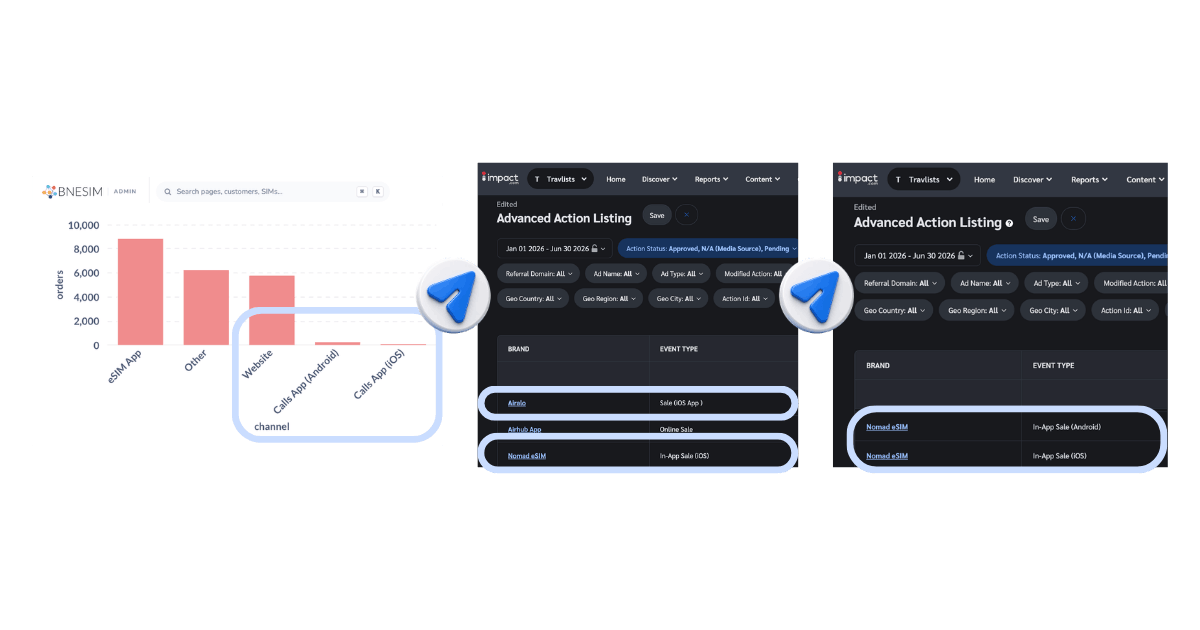
Based on 260 tracked iOS eSIM purchases through Travlists affiliate links from January 1 to June 30, 2026, Airalo was the most booked provider among tracked iPhone purchases: 162 out of 260 purchases, or about 62% of tracked iOS sales.
Airhub and Nomad also appeared among the most booked providers for tracked iOS purchases. eSIMCards, Jetpac Global, Roamless, and Superalink made up smaller but still meaningful shares of readers who chose alternatives to Airalo.
This does not mean Airalo is automatically the best eSIM for every iPhone user. It means that among Travlists purchases where device type was visible, Airalo was the provider most often chosen by iPhone users during this period.
BNESIM’s booking data also shows that both Android and iPhone users are buying through Travlists. Between January and June 2026, Travlists readers completed 3,127 BNESIM purchases through our affiliate links: 1,739 through the eSIM app, 1,258 through the website, and 130 through the Calls app.
The Calls app is the only BNESIM platform where device type is visible because it is distributed as separate Android and iOS versions. During this period, we tracked 115 Android purchases and 15 iPhone purchases through the Calls app.
This does not mean Android users necessarily prefer BNESIM. The difference could reflect BNESIM’s voice + data plans, pricing, how readers chose to purchase, or simply how device information was recorded.
Limitations:
- Yesim, Ubigi, Saily, and GigSky did not provide device-level tracking in this period, so purchases through those providers are not included in the iOS totals above.
- The main BNESIM eSIM app is shared across both operating systems, and website purchases do not report device type, so 2,997 of the 3,127 BNESIM purchases cannot be attributed to either Android or iPhone.
- The Calls app represents only 130 purchases out of more than 3,100 BNESIM bookings, so this should be viewed as an interesting observation rather than evidence of broader market behavior.
- Most purchases across tracked providers do not include device attribution, so these device-level figures reflect only a small portion of total Travlists eSIM sales.
Our booking data reflects purchases made through Travlists affiliate links between January and June 2026. It represents Travlists readers only and should not be interpreted as the overall travel eSIM market.
Other Ways to Stay Connected While Traveling
eSIMs are convenient, but they are not always the best option for every traveler.
Tourist SIM cards, pocket WiFi, international roaming, and even hotel or public WiFi can still make sense depending on your phone, destination, travel group, and how much setup you want to handle after arrival.
Personally, I usually choose an eSIM now because it is easier to buy before a trip and does not require carrying another device. But if you are traveling with family, using several devices, or visiting a country where eSIM compatibility is uncertain, it is still worth comparing the alternatives.
Travlists note: Some older SIM card and pocket WiFi guides are still useful, while others may eventually be merged into destination eSIM guides if they are thin, outdated, or overlap too much with the main connectivity recommendation.
SIM Card & Pocket WiFi Guides
These guides cover physical SIM cards and pocket WiFi options in destinations where travelers may still want a non-eSIM alternative.
More eSIM Guides
Looking for a destination not covered above? Here are more eSIM guides from Travlists, including newer additions as we keep expanding coverage.

Best Bulgaria eSIMs for Tourists 2026: Unlimited Data & Phone Number
Up to 30% off on Bulgaria eSIMs with calls, unlimited data, and monthly plans.
10 Best China eSIMs with VPN & Unlimited Data for Tourists
Discover Beijing, Shanghai, and more with a reliable China eSIM.

10 Best Vietnam eSIMs for Tourists: Unlimited Data & Phone Number
Find the best tourist eSIM in Vietnam with cheap data plans, phone number, and promo codes

Best Switzerland eSIMs 2026: Unlimited Data & Phone Number
Browse Switzerland eSIM data plans that connect to Swisscom or Salt! See options from Ubigi, Airalo, etc. that...
10 Best eSIMs for Europe: Unlimited Data & Phone Number
Discover France, Switzerland, the UK, and more with the best Europe eSIM! Find the best and cheapest options...
10 Best Turkey eSIMs for Tourists: Unlimited Data & Phone Number
Explore Istanbul, Cappadocia, and more with the best Turkey eSIM.

Best Japan eSIMs in 2026: Unlimited Data & Calls
Looking for the best eSIM in Japan? Find options with unlimited data and calls in our guide.

9 Best Netherlands eSIMs for Tourists: Unlimited Data & Phone Number
Immerse yourself in Amsterdam, Rotterdam, The Hague, and more with the best Netherlands eSIM for travelers.
10 Best Taiwan eSIMs for Tourists: Unlimited Data & Phone Number
Explore Taipei, Taichung, Kaohsiung, and more with the best Taiwan eSIM.
10 Best UK eSIMs for Tourists: Unlimited Data & Phone Number
Enjoy up to 30% off with our promo code.
Best Dominican Republic eSIMs 2026: Unlimited Data & Phone Number
Explore Santo Domingo, Santiago de los Caballeros, and more with the best Dominican Republic eSIM for tourists.

Best Sri Lanka eSIMs 2026: Unlimited Data & Phone Number
With any of these embedded SIMs, you can stay connected while exploring Colombo, Kandy, and other spots in...
Frequently Asked Questions
What is a travel eSIM or embedded SIM?
A travel eSIM is a digital SIM card that lets you connect to mobile data abroad without inserting a physical SIM card. You buy a plan online, install it on your phone, and use it for internet access while traveling.
Is an eSIM better than pocket WiFi?
It depends on your trip. An eSIM is usually easier if you only need data for your own phone. Many providers also allow hotspot sharing, although using hotspot can drain your battery faster and may affect speed depending on the provider, plan, and network conditions.
Pocket WiFi can still be useful if you need to connect several devices or share internet with a group. Personally, I usually choose an eSIM because it is often cheaper and easier once you find the right provider.
Will my phone work with an eSIM?
Most newer iPhones, Samsung Galaxy devices, Google Pixel phones, and flagship Android models support eSIM. Some carrier-locked or region-specific models may not.
A quick way to check is to dial *#06# and see if your phone shows an EID. You should also confirm that your phone is unlocked and check your chosen provider’s compatibility list before buying.
Can I keep using WhatsApp with a travel eSIM?
Yes. WhatsApp usually stays linked to your existing phone number even if your travel eSIM is only used for mobile data.
Can I use my physical SIM and eSIM at the same time?
Most modern phones support dual SIM, which lets you keep your physical SIM active while using an eSIM for data. This is useful if you still want to receive calls or texts on your regular number.
I keep a Korean SIM card on my phone and can use it together with a travel eSIM when I travel. That said, roaming costs can add up quickly, so I usually turn off my primary SIM card unless I need it.
Should I buy a regional eSIM or a single-country eSIM?
If you are visiting one country, a single-country eSIM may offer better value. If you are visiting several countries, a regional eSIM may be more convenient because you do not need to install a new plan for every destination.
How much data do I need for travel?
It depends on your trip length and phone habits. Messaging and maps use less data, while streaming, video calls, hotspot use, and social media uploads can use much more.
Can I top up my eSIM if I run out of data?
Many providers allow top-ups, but not all plans support them. Check before buying, especially if you are choosing a smaller plan for a longer trip.
Is unlimited data really unlimited?
Not always in the way travelers expect. Some unlimited eSIMs may have fair usage limits, speed reductions, daily high-speed caps, or hotspot restrictions. Always read the plan details before buying.
When should I install my eSIM?
I usually recommend buying and installing your eSIM before departure, especially if installation requires a QR code. Activation timing depends on the provider, so check whether your plan starts immediately after installation or only after connecting at your destination.
For mainland China, I especially recommend installing your eSIM before arrival and choosing enough data for your full trip.
How Travlists Recommends eSIMs
There are now hundreds of websites recommending travel eSIMs. Some compare dozens of providers using the same specifications copied from provider websites.
That’s not how I approach my recommendations.
Every recommendation starts with the trip itself. Before I even compare providers, I first ask questions like:
- Where are you traveling?
- How long is your trip?
- Will you be visiting one country or several?
- Do you actually need unlimited data?
- Will you need a phone number?
- What’s your budget?
Whenever I write, I try to imagine what I would recommend to my own friends and family if they asked me the same questions.
I’d give them my honest recommendation, but I also know that everyone travels differently. Some prioritize the lowest price, while others care more about convenience, unlimited data, long-term plans, or having a phone number. That’s why I don’t stop at recommending a single provider. I also explain the alternatives and who they’re best suited for.
I also think about what I would personally buy if I were in my reader’s shoes. Even though I have providers I regularly use, they aren’t automatically my first choice for every destination.
The best eSIM for Hong Kong isn’t necessarily the best eSIM for Australia, Turkey, or Croatia. Every guide is written with that in mind.
Once I understand the trip, I compare providers based on the things that actually matter to travelers—network coverage, supported local carriers, plan flexibility, pricing, installation experience, customer support, and the overall value of each plan.
Whenever available, I also include Travlists Booking Insights based on purchases made through our affiliate partners. These insights help show which providers our readers actually booked after reading our guides. Booking behavior supports my recommendations, but it never replaces editorial judgment. The most booked provider isn’t automatically the best provider for every traveler.
I’m also careful about what I don’t claim.
I’ve personally used travel eSIMs across South Korea, Japan, Hong Kong, and the Philippines, and I’ve tested many of the leading global providers. However, I won’t claim to have personally tested every country or measured mobile speeds everywhere. When I haven’t visited a destination myself, I rely on provider documentation, local carrier information, continued research, and traveler feedback rather than making assumptions.
Travlists has always been about helping travelers make better booking decisions. I hope these guides help you choose the eSIM that’s right for your trip, and if they do, I’d be grateful if you came back the next time you’re planning another adventure.
Continue Planning Your Trip
Choosing the right eSIM is only one part of preparing for a trip.
Travlists also covers the other travel essentials that help make planning easier—from applying for visas to getting around your destination and deciding which attractions are worth booking.
Visa Guides
Check visa requirements, entry forms, embassy information, and practical application guides before your trip.
Transportation
Compare airport transfers, rail passes, transport cards, ferries, and city transportation guides.
Attractions & Theme Parks
Find ticket guides, city passes, theme park tips, and booking advice before you buy.
Hotels
Find hotel reviews, neighborhood guides, accommodation recommendations, and booking advice.
South Korea Travel Guide
If you are thinking about going to Seoul, Busan, and other cities in South Korea, start with this guide.
Philippines Travel Guide
See what’s worth booking in Boracay, Manila, and more.
Whether you’re planning your first international trip or your fiftieth, I hope these guides help you travel with a little more confidence.
Safe travels—and see you on your next adventure.
About the author

I’m Julian, the editor and co-founder behind Travlists and a traveler based in Seoul. I write practical travel booking guides for readers who want to know what is actually worth booking before a trip, from mobile data and transport passes to theme park tickets, city cards, and travel essentials. My goal is to make travel booking decisions easier to understand by combining personal travel experience, provider research, screenshots, pricing checks, and Travlists reader booking data where available.